

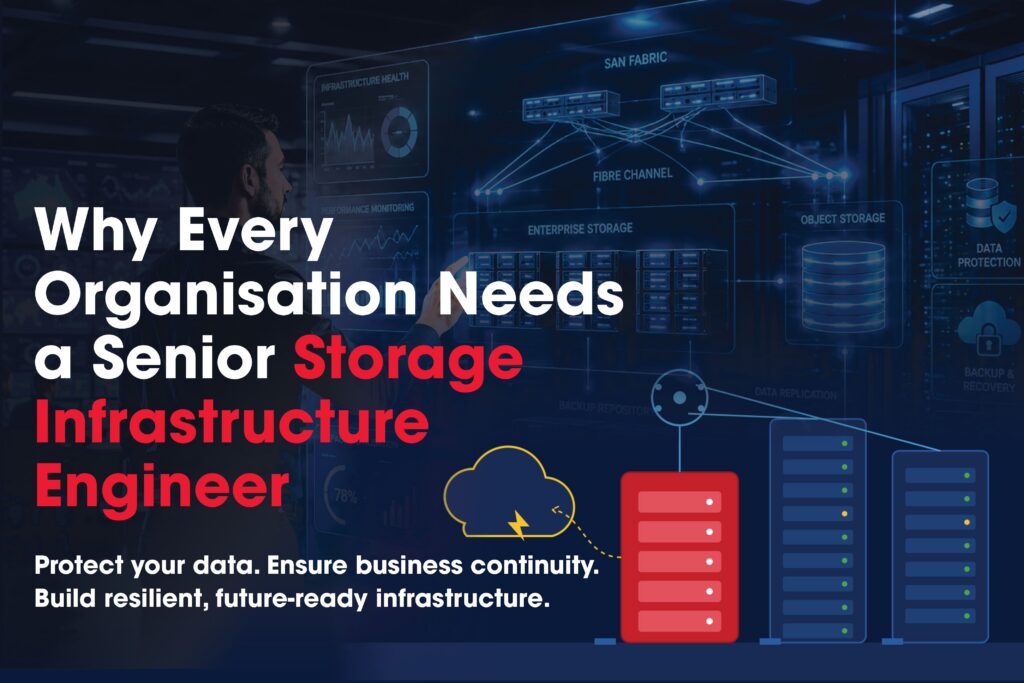
Data doesn’t stop growing. Every email, transaction, patient record, and backup job your organisation runs depends on storage infrastructure working quietly in the background — until it doesn’t. When a SAN switch misbehaves or a backup fails silently, the cost isn’t just technical. It’s operational downtime, compliance risk, and lost trust.
That’s where a Senior Storage Infrastructure Engineer comes in — and why finding the right one (or the right partner to supply one) has become a priority for both government agencies and private enterprises across Australia and New Zealand.
What Does a Storage Infrastructure Engineer Actually Do?
In simple terms, this role is responsible for the systems that store, protect, and move your organisation’s data. That includes:
- Designing and maintaining SAN (Storage Area Network) environments — the high-speed networks that connect servers to storage devices.
- Managing Fibre Channel block storage systems, which handle the fast, reliable data transfer that mission-critical applications depend on.
- Configuring and tuning enterprise storage platforms such as HPE 3PAR, Primera, and Alletra, NetApp E-Series, and Dell Data Domain.
- Administering Brocade fabric switches and SANnav for network visibility and performance monitoring.
- Working with modern object storage, like Scality Artesca, for scalable, software-defined storage needs.
- Building resilient backup and disaster recovery strategies using Veeam Backup & Replication, so your organisation can recover quickly from outages, ransomware, or human error.
Beyond the technical skill set, a strong engineer in this role can also document processes clearly, communicate with both technical teams and business stakeholders, and coach junior staff — making them a long-term asset, not just a fix for a single project.
Why This Role Matters More Than Ever
1. Government agencies are under pressure to modernise safely
Public sector IT teams are managing legacy storage systems while being asked to modernise, cut costs, and meet strict data sovereignty and security requirements — all at once. A skilled storage engineer helps bridge that gap without introducing risk.
2. Private enterprises can’t afford storage downtime
For manufacturing, aged care, finance, and other data-heavy sectors, a storage outage doesn’t just mean an IT ticket — it can mean halted production lines, delayed patient care, or failed audits.
3. Backup is not optional anymore
Ransomware and data loss events are common enough that “we have backups” isn’t enough. Organisations need a properly architected, tested, and resilient backup strategy — something a Veeam-experienced engineer is specifically trained to build.
4. The skills shortage is real
Deep expertise in Broadcom SAN switches, Fibre Channel storage, and enterprise platforms like HPE 3PAR or NetApp E-Series is scarce. Many organisations don’t need a full-time hire — they need flexible access to the right expertise, when they need it.
How a Storage Infrastructure Engineer Helps Your Organisation
| Business Need | How the Role Helps |
| Reduce downtime risk | Proactive tuning and monitoring of SAN and storage systems before failures occur |
| Strengthen disaster recovery | Designs and tests backup strategies using Veeam so recovery is fast and reliable |
| Support audits and compliance | Produces clear design, build, and operations documentation |
| Upskill internal teams | Coaches existing staff and presents recommendations to stakeholders |
| Modernise legacy infrastructure | Plans migrations across HPE, NetApp, Dell, and Brocade environments with minimal disruption |
Government and Private Sector: What to Look for in a Storage Engineer
If you’re an IT manager, procurement lead, or program director evaluating vendors or candidates for this role, look for demonstrated experience across:
- Broadcom SAN switches and Fibre Channel block storage
- At least one enterprise storage platform (HPE 3PAR / Primera / Alletra, NetApp E-Series, Dell Data Domain)
- Brocade fabric switches and SANnav for fabric management
- Scality Artesca or similar object storage platforms
- Veeam Backup & Replication for backup and disaster recovery
- A track record of writing operational documentation, not just “getting it done” informally
SoftLabs People Solutions: The Right Talent, Without the Hiring Risk
Finding someone who genuinely has this breadth of experience, and who can communicate it clearly to both engineers and executives is hard. That’s the gap SoftLabs’ People Solutions practice is built to close.
As a women-led, ISO-certified Australian technology consulting company working across Government, Manufacturing, Aged Care, and the SME sector, SoftLabs helps organisations access experienced Senior Storage Infrastructure Engineers and broader IT talent, on a contract, project, or ongoing basis, without the time and risk of running the search alone.
Whether you’re a government agency needing documented, compliant infrastructure support, or a private organisation building a more resilient backup strategy, SoftLabs can help you find the right person for the job.
Looking for storage infrastructure talent for your team? Get in touch with SoftLabs’ People Solutions team to discuss your requirements.
Frequently Asked Questions
What is a Storage Infrastructure Engineer?
A Storage Infrastructure Engineer designs, manages, and troubleshoots the systems that store and protect an organisation’s data, including SAN networks, Fibre Channel storage, and backup platforms like Veeam.
Why do government agencies need storage infrastructure specialists?
Government agencies manage large volumes of sensitive data under strict compliance and uptime requirements. A specialist ensures storage systems are reliable, documented, and audit-ready.
What is the difference between SAN storage and backup systems?
SAN (Storage Area Network) storage is where active data lives and is accessed day-to-day. Backup systems, like those built with Veeam, create separate, recoverable copies of that data in case of failure, error, or attack.
Can SoftLabs provide contract or temporary storage engineers?
Yes. SoftLabs’ People Solutions practice supplies experienced IT professionals, including Senior Storage Infrastructure Engineers, on a contract, project, or permanent basis for public and private sector clients across Australia and New Zealand.
